April 1, 2025
In the years post-pandemic, several of the Ivy League institutions (along with their shadowed, loosely defined cousins, the “Ivy Plus” universities) have re-instituted their policy of requiring the SAT for admission. I have said several times in public, and I’ll repeat here, that I don’t care if they do or they don’t, even if their public attempts to justify their decisions are pretty weak. But now that April 1 has arrived, admissions decisions are out for Fall, and we’re entering yield season, I can throw my ample weight behind yet another opinion.
On the whole, I think going back to the SAT is a great thing for these institutions, for higher education, and for society, for a few reasons:
- It seems to decrease the number of applications they receive. Dartmouth dropped 11%, Yale is touting its “third largest application volume ever” (admissions code for a decrease) and others seem eerily silent on numbers, ostensibly because colleges are reacting to the political climate around diversity and SCOTUS decisions and Dear Colleague Letters, but possibly because they just don’t want to admit a decrease publicly, as is their right. If you are watching what’s happening in Washington, you should know by now that less transparency is good for democracy, of course, especially when you are talking about doing the right thing. Or is it the wrong thing? It’s hard to keep those two concepts straight these days.
- Reading fewer applications can result in lower administrative costs, which might have a teeny effect on the costs of these institutions, which is now over $100,000 per year (using full Cost of Attendance figures.) This will convince the family making $30,000 a year that they can still afford an elite education, making them grist for the rejection mill, even if we know the Poorz are, in the eyes of Carl Brigham et al, not quite as sharp as the Richez, and therefore don’t stand a chance with those scores they present. So, MAGA and all that stuff. I was born in the 1950’s. It wasn’t that bad, other than the polio and the measles and the segregation, of course.
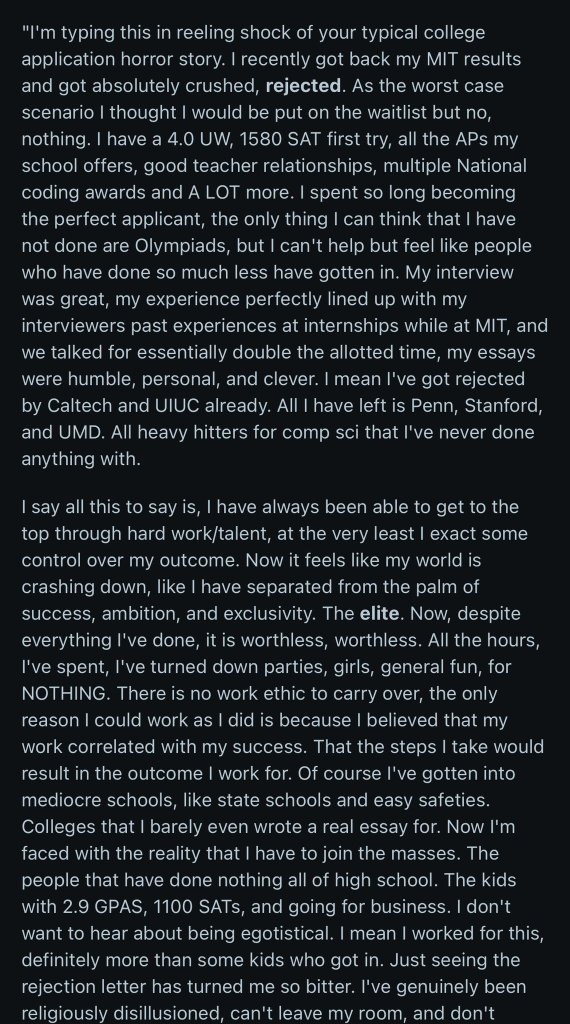
- It can have a positive collective effect on the mental health of our nation’s teenagers. In a more perfect world, a decrease in application numbers and an increase in reliance on test scores would mean this student would be able to enroll at MIT instead of your institution. Think of how good having them not enroll would be for your campus and for your students.


- Teachers, too, will be happy. The focus on getting the “right” answer is exactly why teachers love multiple choice tests; there is no arguing with parents and students about the nuances of things like the cause of The Civil War, for instance. Of course, the right answer can vary by region (something College Board knows all too well), so check with your local militia first.
- And AI? Really good for AI, which can now teach the classes and do test prep all at the same time (even though at some schools, test prep is already embedded in the far inferior human instruction.)
- It will be good for business. Imagine how alumni response to higher admit rates will cause the phones to ring at RNL, EAB, and all the higher education consulting companies who will be tasked with generating more applications. Can you even imagine the “Click here on this email link and you’ve applied to Princeton with no application fee” disruption that will ripple through the hallowed halls across the Northeast? I mean, all the Ivy alumni at McKinsey have to hire someone, and they sure as hell ain’t going to settle for anyone from a college that admits 12% of applicants. If that pipeline dries up, what’s even the value of spending a half-million on college?
- Vegas can start posting odds about the next institution to fall, and you might get rich if you do your homework. Ohio State beat Michigan in closing its DEI Office; now they jumped first in going back to the SAT (but Michigan of course beat them in football, unless you count the last game of the year). Imagine the odds on the Duke/Notre Dame or Vanderbilt/Wash U rivalries. Imagine the construction jobs it will create on the Strip.
- The south won’t feel so special anymore. Texas, Florida, Georgia, Tennessee, and Purdue can still look down their noses at Louisiana, Mississippi, Arkansas and Alabama, but they won’t be able to say “Bless their hearts, they’re test-optional” to our friends in New England anymore. And that’s a good thing.
So, before tomorrow, April 2nd, feel free to share this with all your friends in Enrollment Management who might be on the cusp. I’m sure they’ll be grateful. If you work at a place like Cal Tech, just a note to the faculty will suffice.
Let’s just wrap up our experience with an observation from the late, great Bill Walton: “Think Oscar Wilde when he said, ‘every saint has a past, every sinner has a future.’ But also think Neil Young. ‘The fork in the road, light a candle’. Instead of cursing the darkness, let’s light a candle for where we’re going. This was fantastic for the world. We are better people for having been here. It was absolutely incredible. I’m inspired. I don’t know when I’ll ever sleep again.”
 Jon Boeckenstedt's Admissions Weblog
This confuses me. Does this mean they will ONLY look at the SAT, no longer considering ACT? I can’t find news about this elsewhere.
LikeLike
You should read the link in Akil Bello’s post on LinkedIn
LikeLike
https://www.linkedin.com/posts/akil-bello_private-equity-backed-act-has-announced-an-activity-7312790840022630400-dTgs?utm_source=share&utm_medium=member_android&rcm=ACoAAABNA7ABMV55nKMglL0SvApEwmWnVHl6Zrg
LikeLike
Jon – nice to hear you’re still philosophizing. I believe we exchanged some emails years ago wherein I argued to bring back standardized admissions test as part of the admissions process and you felt differently while heading up Admissions at OSU? Incorrect memory?
LikeLike
Hi Craig. I still think the SAT is an awful test. Note the date on the post…..
LikeLike